Clustered
around the head of the 68-mile-long Oslofjord, Oslo is probably the most
spacious city in the world. Its 175-square-mile metropolitan area
consists of over 75 percent forests and five percent water. Its fine
deep harbor, Pipervika, stretches into the heart of the city and from it
leave ferries to Denmark and Germany.
Surstromming:
One
of the World's Strangest Dishes by Bob Brooke
Inevitably
the fish would ferment and whole villages would stink of it but the
inhabitants came to consider such fermented fish a delicacy. One type–
surstromming or sour Baltic herring–survives in Sweden. Surely
this has to be one of the world's strangest dishes and a potent
expression of the saying that one man's meat is another man's poison.
Caught in the months of May and June,
processors immerse the fish for a day in brine and then decapitate and
clean it. Next they stack it in barrels, trundling it out into the
summer sun and left there for 24 hours to get the fermenting process
started. An inch or two of space is left at the top of each barrel so
that any gas formed during the fermentation can accumulate with out
causing an explosion.
Put into a cool storage room, the herring
ferment at a slower rate. As they do, their aroma grows progressively
stronger, and only the most acute nose can determine the precise point
at which they are ready for canning.
Among those who like surstromming best, and its
fans are many, there's the belief that the contents of a can left for a
year at a temperature of 68̊ F. actually improve; the can will have
begun to swell, and at its puffiest must be opened gingerly, like a
bottle of champagne.
Swedes eat ripe surstromming with paper-thin
hard bread and boiled potatoes, usually an almond-shaped variety that
comes from the north. It has a sharp, cutting taste. Sometimes, they
drink milk with it, but beer and aquavit more often accompany the dish.
Some Swedes down it without a second thought to its smell; others, in
order to partake of it at all, first have to rinse it in purifying soda
water.
Sales of surstromming are on the increase in
Sweden, but its future as an export item is, predictably, dim. Although
800 cans of it used to be exported annually to Hollywood when a Swedish
movie colony could still be found there, U.S. customs officials have
since come to view it with suspicion, despite its proven nontoxicity.
Moreover, the product doesn’t always travel well. Only recently a
Swede found this out. Thinking to amaze an important New York client and
the assembled board of directors with so bizarre a food, he produced the
swollen can he had carried all the way from Sweden in his luggage and
dramatically laid it on the table. At that moment, the can exploded.
Every year about 95 000 people die in
Sweden and, according to the law, everyone must be buried. There must be
room for everyone in the cemeteries, therefore the future needs of space
have to be predicted. Because of this funerals must be part of the
planning process.
In
the early Middle Ages, driven by famine at home and the promise of
wealth to be had in other lands, the Vikings set out from Scandinavia to
conquer parts of England, Ireland, France, Russia, and even Turkey.
Bolstered by their successes, the Vikings pushed westward, eventually
crossing the North Atlantic and founding settlements in Iceland,
Greenland, and Newfoundland in Canada. Read
moreGo to the Book Shop >














 Clustered
around the head of the 68-mile-long Oslofjord, Oslo is probably the most
spacious city in the world. Its 175-square-mile metropolitan area
consists of over 75 percent forests and five percent water. Its fine
deep harbor, Pipervika, stretches into the heart of the city and from it
leave ferries to Denmark and Germany.
Clustered
around the head of the 68-mile-long Oslofjord, Oslo is probably the most
spacious city in the world. Its 175-square-mile metropolitan area
consists of over 75 percent forests and five percent water. Its fine
deep harbor, Pipervika, stretches into the heart of the city and from it
leave ferries to Denmark and Germany.


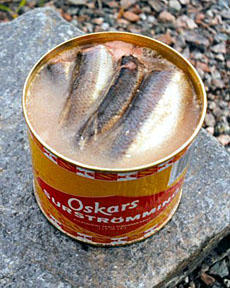 Among those who like surstromming best, and its
fans are many, there's the belief that the contents of a can left for a
year at a temperature of 68̊ F. actually improve; the can will have
begun to swell, and at its puffiest must be opened gingerly, like a
bottle of champagne.
Among those who like surstromming best, and its
fans are many, there's the belief that the contents of a can left for a
year at a temperature of 68̊ F. actually improve; the can will have
begun to swell, and at its puffiest must be opened gingerly, like a
bottle of champagne.

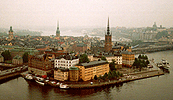

 In
the early Middle Ages, driven by famine at home and the promise of
wealth to be had in other lands, the Vikings set out from Scandinavia to
conquer parts of England, Ireland, France, Russia, and even Turkey.
Bolstered by their successes, the Vikings pushed westward, eventually
crossing the North Atlantic and founding settlements in Iceland,
Greenland, and Newfoundland in Canada.
In
the early Middle Ages, driven by famine at home and the promise of
wealth to be had in other lands, the Vikings set out from Scandinavia to
conquer parts of England, Ireland, France, Russia, and even Turkey.
Bolstered by their successes, the Vikings pushed westward, eventually
crossing the North Atlantic and founding settlements in Iceland,
Greenland, and Newfoundland in Canada.