Clustered
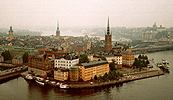
around the head of the 68-mile-long Oslofjord, Oslo is probably the most
spacious city in the world. Its 175-square-mile metropolitan area
consists of over 75 percent forests and five percent water. Its fine
deep harbor, Pipervika, stretches into the heart of the city and from it
leave ferries to Denmark and Germany.
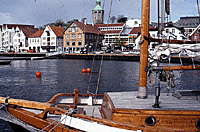
At first glance, Gamle Stavanger, or Old Stavanger,
the area of town closest to the water, looks like a transplanted,
salty New England village, with its cobblestone streets lined with
one and two-story wooden houses faced with white clapboard. The air
smells salty, too, since the town lies along the Norway’s southwest
coast.
Nutritional
experts say a traditional Nordic diet is just as healthful as a
Mediterranean one. In fact, it includes a lot of the same
ingredients—fish, fruits and vegetables, whole grain breads. According to a study that conducted in Sweden, Denmark, Finland and
Iceland by the Nordiska
ministerrådet (the Nordic Council of
Ministers), a healthy, Nordic diet will decrease cardiovascular diseases
and the risk for Type 2 Diabetes,.
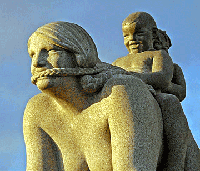
Many
artists have tried to interpret the pathos that is the human condition.
In many ways, Gustav Vigeland, the Norwegian sculptor, succeeded. His
lasting legacy is a monumental lifetime work that occupies a 75-acre
park in Oslo. Vigeland once said, "I was a sculptor before I was born. I was driven
and lashed onward by powerful forces outside myself. There was no other
path, and no matter how hard I might have tried to find one, I would
have been forced back again."
Finns are much older than
Finland, itself. Excavations in Ristola, near Lahti, confirm
that hundreds of people lived there 10,000 years ago. The
earliest settlers migrated to southern Finland from present-day
Estonia about 8,000 years ago.
HENRIK IBSEN
is Norway's most famous playwright, known for three of the
most widely performed plays in the world—Hedda Gabler, A Doll's
House, and Peer Gynt. He also wrote many others, as well as over
300 poems. Today, his statue stands guard in front of the
National Theater in Oslo.
In
the early Middle Ages, driven by famine at home and the promise
of wealth to be had in other lands, the Vikings set out from
Scandinavia to conquer parts of England, Ireland, France,
Russia, and even Turkey. Bolstered by their successes, the
Vikings pushed westward, eventually crossing the North Atlantic
and founding settlements in Iceland, Greenland, and Newfoundland
in Canada.
Read moreGo to the Book Shop >














 Clustered
around the head of the 68-mile-long Oslofjord, Oslo is probably the most
spacious city in the world. Its 175-square-mile metropolitan area
consists of over 75 percent forests and five percent water. Its fine
deep harbor, Pipervika, stretches into the heart of the city and from it
leave ferries to Denmark and Germany.
Clustered
around the head of the 68-mile-long Oslofjord, Oslo is probably the most
spacious city in the world. Its 175-square-mile metropolitan area
consists of over 75 percent forests and five percent water. Its fine
deep harbor, Pipervika, stretches into the heart of the city and from it
leave ferries to Denmark and Germany.


 At first glance, Gamle Stavanger, or Old Stavanger,
the area of town closest to the water, looks like a transplanted,
salty New England village, with its cobblestone streets lined with
one and two-story wooden houses faced with white clapboard. The air
smells salty, too, since the town lies along the Norway’s southwest
coast.
At first glance, Gamle Stavanger, or Old Stavanger,
the area of town closest to the water, looks like a transplanted,
salty New England village, with its cobblestone streets lined with
one and two-story wooden houses faced with white clapboard. The air
smells salty, too, since the town lies along the Norway’s southwest
coast.
 Nutritional
experts say a traditional Nordic diet is just as healthful as a
Mediterranean one. In fact, it includes a lot of the same
ingredients—fish, fruits and vegetables, whole grain breads. According to a study that conducted in Sweden, Denmark, Finland and
Iceland by the
Nutritional
experts say a traditional Nordic diet is just as healthful as a
Mediterranean one. In fact, it includes a lot of the same
ingredients—fish, fruits and vegetables, whole grain breads. According to a study that conducted in Sweden, Denmark, Finland and
Iceland by the 
 Many
artists have tried to interpret the pathos that is the human condition.
In many ways, Gustav Vigeland, the Norwegian sculptor, succeeded. His
lasting legacy is a monumental lifetime work that occupies a 75-acre
park in Oslo. Vigeland once said, "I was a sculptor before I was born. I was driven
and lashed onward by powerful forces outside myself. There was no other
path, and no matter how hard I might have tried to find one, I would
have been forced back again."
Many
artists have tried to interpret the pathos that is the human condition.
In many ways, Gustav Vigeland, the Norwegian sculptor, succeeded. His
lasting legacy is a monumental lifetime work that occupies a 75-acre
park in Oslo. Vigeland once said, "I was a sculptor before I was born. I was driven
and lashed onward by powerful forces outside myself. There was no other
path, and no matter how hard I might have tried to find one, I would
have been forced back again."



 In
the early Middle Ages, driven by famine at home and the promise
of wealth to be had in other lands, the Vikings set out from
Scandinavia to conquer parts of England, Ireland, France,
Russia, and even Turkey. Bolstered by their successes, the
Vikings pushed westward, eventually crossing the North Atlantic
and founding settlements in Iceland, Greenland, and Newfoundland
in Canada.
In
the early Middle Ages, driven by famine at home and the promise
of wealth to be had in other lands, the Vikings set out from
Scandinavia to conquer parts of England, Ireland, France,
Russia, and even Turkey. Bolstered by their successes, the
Vikings pushed westward, eventually crossing the North Atlantic
and founding settlements in Iceland, Greenland, and Newfoundland
in Canada.