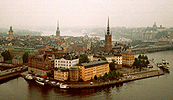
Clustered
around the head of the 68-mile-long Oslofjord, Oslo is probably the most
spacious city in the world. Its 175-square-mile metropolitan area
consists of over 75 percent forests and five percent water. Its fine
deep harbor, Pipervika, stretches into the heart of the city and from it
leave ferries to Denmark and Germany.
Salt
herring played a major role in the destiny of Europe. By the 12th
Century, it was a staple of the European diet, and it’s easy to see
why. Two of these fatty fish furnish roughly 600 calories and two and a
half ounces of protein. This is just about all the protein a person
needs in a day.
Salt herring saved many
an inhabitant of a beleaguered city from starvation and fed many an army
on the march and in camp. Indirectly it helped start some of Europe's
greatest navies. More than one sailor learned the rudiments of
seamanship in a herring boat.
But even with this most
plentiful of foods the Scandinavians had a somewhat fragile
relationship. The herring, appearing offshore one year in shoals a half
dozen miles long and wide, the next year could vanish almost completely.
Explanations of the phenomenon varied as much as the runs.
As early as the l0th
century a historian called Snorro attributed a magnificent herring run
and a fine harvest to a beneficent reign. But when the herring stopped
running, the blame was laid on "magic, bad men having sunk a copper
horse in the sea." In 1549 the government of Denmark (which then
ruled Norway) was sufficiently worried about the possibility of a
decrease in the catch to issue an edict: "Since there is danger
that God may withdraw his blessing on account of the great sins and
vices of inhabitants of the coasts, our tax gatherers, each one in his
own district, shall see to it that the people in the fishing stations
lead good and Christian lives; that there is preaching every Sunday, and
people exhorted to lead a Godly life, so that God may be moved by the
prayers of good Christians to extend his blessing to us also in the
future."
So venerated was the
herring that it was looked upon as a bearer of divine messages. In 1587
anxiety spread through the realm when two herring fished from the North
Sea off the coast of Norway flopped over to reveal Gothic letters on
their sides. The Danish king interpreted the letters as foretelling his
death, but three wise men intervened and read the message differently:
"You will not fish for herring so well in the future as other
nations." This turned out to be true, but since that interpretation
was no less gloomy than the first, other learned men took up the task of
trying to figure out the fish-borne prophecy. One scholar published a
work that argued that the herring's message spelled the doom of Europe.
Even when the herring
were abundant, there was always the hazard that there wouldn’t be
enough salt available to preserve the catch. The Baltic's waters are too
sweet to yield salt in any appreciable amount, and although the salinity
of the North Sea is higher, a pale and unreliable sun prevented the
Scandinavians from utilizing with much success the evaporation method
employed by the French and the Spaniards. When dune grass was burned
along Denmark's west coast to extract the salt from the grass, a method
followed by the Dutch, the destruction of the plants enabled the sand to
spread, overwhelming gardens and farms. The Scandinavians had no
alternative but to import their salt, and in this the Germans saw an
opportunity. The merchants of Lubeck began exchanging it for goods and
wound up by moving en masse into Scandinavian ports, eventually taking
over the lucrative herring trade. The imposing Gothic ruins of the
Hanseatic League city of Visby on the island of Gotland Sweden, attest
to the power and wealth the German Hansas thus obtained for themselves.
Every year about 95 000 people die in
Sweden and, according to the law, everyone must be buried. There must be
room for everyone in the cemeteries, therefore the future needs of space
have to be predicted. Because of this funerals must be part of the
planning process.
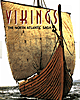
In
the early Middle Ages, driven by famine at home and the promise of
wealth to be had in other lands, the Vikings set out from Scandinavia to
conquer parts of England, Ireland, France, Russia, and even Turkey.
Bolstered by their successes, the Vikings pushed westward, eventually
crossing the North Atlantic and founding settlements in Iceland,
Greenland, and Newfoundland in Canada. Read
moreGo to the Book Shop >














 Clustered
around the head of the 68-mile-long Oslofjord, Oslo is probably the most
spacious city in the world. Its 175-square-mile metropolitan area
consists of over 75 percent forests and five percent water. Its fine
deep harbor, Pipervika, stretches into the heart of the city and from it
leave ferries to Denmark and Germany.
Clustered
around the head of the 68-mile-long Oslofjord, Oslo is probably the most
spacious city in the world. Its 175-square-mile metropolitan area
consists of over 75 percent forests and five percent water. Its fine
deep harbor, Pipervika, stretches into the heart of the city and from it
leave ferries to Denmark and Germany.

 Salt
herring played a major role in the destiny of Europe. By the 12th
Century, it was a staple of the European diet, and it’s easy to see
why. Two of these fatty fish furnish roughly 600 calories and two and a
half ounces of protein. This is just about all the protein a person
needs in a day.
Salt
herring played a major role in the destiny of Europe. By the 12th
Century, it was a staple of the European diet, and it’s easy to see
why. Two of these fatty fish furnish roughly 600 calories and two and a
half ounces of protein. This is just about all the protein a person
needs in a day. So venerated was the
herring that it was looked upon as a bearer of divine messages. In 1587
anxiety spread through the realm when two herring fished from the North
Sea off the coast of Norway flopped over to reveal Gothic letters on
their sides. The Danish king interpreted the letters as foretelling his
death, but three wise men intervened and read the message differently:
"You will not fish for herring so well in the future as other
nations." This turned out to be true, but since that interpretation
was no less gloomy than the first, other learned men took up the task of
trying to figure out the fish-borne prophecy. One scholar published a
work that argued that the herring's message spelled the doom of Europe.
So venerated was the
herring that it was looked upon as a bearer of divine messages. In 1587
anxiety spread through the realm when two herring fished from the North
Sea off the coast of Norway flopped over to reveal Gothic letters on
their sides. The Danish king interpreted the letters as foretelling his
death, but three wise men intervened and read the message differently:
"You will not fish for herring so well in the future as other
nations." This turned out to be true, but since that interpretation
was no less gloomy than the first, other learned men took up the task of
trying to figure out the fish-borne prophecy. One scholar published a
work that argued that the herring's message spelled the doom of Europe.


 In
the early Middle Ages, driven by famine at home and the promise of
wealth to be had in other lands, the Vikings set out from Scandinavia to
conquer parts of England, Ireland, France, Russia, and even Turkey.
Bolstered by their successes, the Vikings pushed westward, eventually
crossing the North Atlantic and founding settlements in Iceland,
Greenland, and Newfoundland in Canada.
In
the early Middle Ages, driven by famine at home and the promise of
wealth to be had in other lands, the Vikings set out from Scandinavia to
conquer parts of England, Ireland, France, Russia, and even Turkey.
Bolstered by their successes, the Vikings pushed westward, eventually
crossing the North Atlantic and founding settlements in Iceland,
Greenland, and Newfoundland in Canada.