What's
in an Icelandic Name?
by Bob Brooke
  Only
in Iceland has the centuries-old Scandinavian pattern of naming
continued down to the present. A person’s given name is his or her
primary name. The telephone directory lists individuals by their
Christian name such as Jon. Only
in Iceland has the centuries-old Scandinavian pattern of naming
continued down to the present. A person’s given name is his or her
primary name. The telephone directory lists individuals by their
Christian name such as Jon.
Icelanders have also
retained the old system of patronymics. Thus by adding son or dottir
to the possessive of a person’s father’s name, the son of Sigurd
becomes Jon Sigurdsson and his son Sveinn becomes Sveinn Jonsson and his
daughter Helga, Helga Jonsdottir. And so on. Women also don’t change
their names when they marry.
Everywhere else in
Scandinavia family names became legally necessary in the 19th and early
20th century. In 1913, Iceland’s Assembly, the Althing, passed
legislation that required citizens to petition the government in order
to adopt a family name. By 1915, the law added that the family name must
be a suitable one, therefore, official lists of suitable family names
had to be created. The Althing adopted this legislation to prevent names
of foreign origin from being adopted.
In 1855, there were 108
different family names in Iceland. By 1910, the number had increased to
297. By 1925, additional legislation prohibited the adoption of family
names altogether, although it allowed those who already had them to keep
them. The law also made the adoption of an Icelandic family name and
patronymic a pre-requisite for obtaining Icelandic citizenship. As time
goes on, fewer individuals will have family names as more and more
individuals drop them in favor of the traditional naming system.
While the most popular
male name in Saga Times was Thor, it’s now, and has been for the last
four centuries, Jón. The most popular female name since 1100 A.D. has
been Guðrún. No such continuity characterizes Anglo-Saxon names in use
a millennium ago.
In spite of the
continuity of Icelandic names over the 11 centuries of Icelandic
history, there have been some trends. For instance, there has been a
decline in the number of persons named after Thor. In pre-Christian
times, about 25 percent of all names honored this most vital of all
Viking gods. But after the establishment of Christianity, the number of
Thor names began to decline.
From the beginning of
Christianity, there has been a continual increase in the use of biblical
and Christian names among the Icelandic people. Names such as Jón,
Pétur, Páll, and Margrét are common. Still the great majority of
Icelanders down to the present have borne Old Norse names.
Until the 18th century,
virtually no Icelanders had more than one name. In the 1703 census, only
two individuals, a brother and sister, had two given names. In the 1950
census, 52 percent of the population had two or more given names.
From the beginning of
their history, Icelanders have continually made up new names by
compounding names. This process increased tremendously during the 19th
century. And since the 19th century, there has been an increasing
tendency toward using foreign names–a few such as Kristinn and Hulda
have become common–a trend distressing to some Icelanders. Most of the
leading names in Iceland have come to the island by way of Denmark.
The use of non-intimate
nicknames has nearly disappeared. Before Christianity, 25 percent of the
males listed in the Book of Settlements had nicknames, not
counting those names compounded with an occupation or a place name or
those referring to age–that is, the elder or the younger. The same
trend applies to women’s names. However, women have been less likely
than men to have nicknames. The old nicknames often were graphically
descriptive or derogatory–Auðun the Stutterer, Eystein Foul-Fart, Ulf
the Squint-eyed, Thorberg Ship-Breast, or Ljótur the Unwashed.
Throughout Icelandic
history, the majority of the population used relatively few names. For
instance, 25 percent of the males since the 13th century have been names
Jón. Over half the males in the 1703 census held the 10 most frequently
used male names. The same held true for women. The most popular name
among them was Guðrún. The greatest increase in the number of
different names for both men and women occurred from 1921 to 1950.
Several patterns in
naming children have persisted since Saga Times and earlier. Though sons
have often been named after their fathers, this has never been a common
pattern either among Old Norse or modern Icelanders. Rarely have
daughters been named after their mothers.
Three naming patterns
have been commonly used–alliteration, variation, and commemoration.
Today, Icelandic parents continue to name their children with
alliterative combinations, such as Gunnar or Gunnilla.
More commonly used has
been the variation concept. Here names with similar beginnings or
endings have been used to show family relationships. In Iceland,
variations of the first element of name rather than the last element
have been much more common. The helpful brothers in Hrafnkel’s Saga
were named Thorgeir and Thorbjörn.
Far more common than
either of these naming patterns has been commemoration, particularly the
naming of a son after an ancestor, especially a paternal grandfather.
Ari Thorgilsson, the father of Icelandic history, has a son named
Thorgils Arason, who in turn, had a son named Ari Thorgilsson. It has
always been common in Iceland to have name reversals such as this. Thus
a high percentage of Icelandic males have the same names as their
paternal grandfathers.
< Back to Iceland
Basics
Go to Iceland's Sagas > |














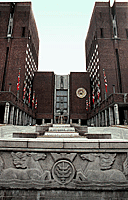 Clustered
around the head of the 68-mile-long Oslofjord, Oslo is probably the most
spacious city in the world. Its 175-square-mile metropolitan area
consists of over 75 percent forests and five percent water. Its fine
deep harbor, Pipervika, stretches into the heart of the city and from it
leave ferries to Denmark and Germany.
Clustered
around the head of the 68-mile-long Oslofjord, Oslo is probably the most
spacious city in the world. Its 175-square-mile metropolitan area
consists of over 75 percent forests and five percent water. Its fine
deep harbor, Pipervika, stretches into the heart of the city and from it
leave ferries to Denmark and Germany.




 In
the early Middle Ages, driven by famine at home and the promise of
wealth to be had in other lands, the Vikings set out from Scandinavia to
conquer parts of England, Ireland, France, Russia, and even Turkey.
Bolstered by their successes, the Vikings pushed westward, eventually
crossing the North Atlantic and founding settlements in Iceland,
Greenland, and Newfoundland in Canada.
In
the early Middle Ages, driven by famine at home and the promise of
wealth to be had in other lands, the Vikings set out from Scandinavia to
conquer parts of England, Ireland, France, Russia, and even Turkey.
Bolstered by their successes, the Vikings pushed westward, eventually
crossing the North Atlantic and founding settlements in Iceland,
Greenland, and Newfoundland in Canada.