Clustered
around the head of the 68-mile-long Oslofjord, Oslo is probably the most
spacious city in the world. Its 175-square-mile metropolitan area
consists of over 75 percent forests and five percent water. Its fine
deep harbor, Pipervika, stretches into the heart of the city and from it
leave ferries to Denmark and Germany.
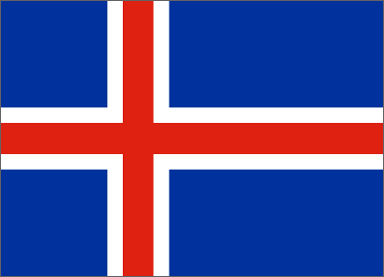
Iceland
is a young land still in the making. Far flung out to sea, Iceland
straddles the Mid-Atlantic Ridge, a 12,000-mile section of submarine
mountain ranges created by the upheavals of the Earth's crust many
millions of years ago. As the continents of North America and Europe
slowly creep further apart, the Atlantic Ocean floor widens at the rate
of about one inch a year and, along with it, Iceland widens, too. The
oldest rocks yet dated are only about 16 million years old. There are
few other places in the world where people are more aware of nature's
immutable forces than in Iceland.
Of her total area of 39,750square miles, only
about a quarter is habitable, mostly in the coastal areas and in some of
the broad valleys running down to the coast from the highlands.
Glaciers, volcanoes and their attendant expanses of lava, other
non-volcanic mountains, hot springs, sand and gravel deserts and large
stretches of stony wilderness make up this rugged country. Waterways
ranging from rushing rivers and chattering streams to numerous lakes
liberally dot the countryside.
Glaciers cover 11 percent of the country. The
largest, Vatnajokull, is a sprawling white mass of 3,240 square miles–as
big as all the glaciers of continental Europe put together. In
thickness, it reaches an impressive 3,280 feet, and one of its outlets
extends to about 400 feet below sea level. In the south of this massif
is Iceland's highest point, Oraefajokull at 6,950 feet. Four other
mighty glaciers–Langj6kull and Hofsjokull in the Central Highlands,
Myrdalsjokull in the south, and Drangajokull in the north west–help to
keep this island nation rugged and pure. There are numerous smaller
ones, also, so that there’s rarely a time when an ice cap isn’t on
or just over the horizon.
This science fiction landscape forms the
backdrop to a deep-rooted Icelandic culture, which flourished in the
farms and small communities from early medieval times and survives in
the sagas and other early Icelandic literature. Another remnant of those
early times is the Althing, Iceland’s Parliament, one of the world's
oldest democratic legislative bodies.
The Icelanders have harnessed many of the
forces of nature to provide power and heating for the needs of their
modern society and to inject a much-needed diversification into the
national economy. Until recent years, fishing and its by-products
provided the basis for the economy of this small country. Today, Iceland
sells its energy to an increasing number of foreign investors. But even
this hasn’t helped to alleviate Iceland’s massive inflation rate,
which necessitates the review of salaries and foreign exchange rates
several times a year.
It’s only been a few years since engineers
built a road along the southeast coast at the foot of Vatnajokull
massif, completing a route around the entire island. This helped to open
up formerly remote areas to residents and visitors alike.
Every year about 95 000 people die in
Sweden and, according to the law, everyone must be buried. There must be
room for everyone in the cemeteries, therefore the future needs of space
have to be predicted. Because of this funerals must be part of the
planning process.
In
the early Middle Ages, driven by famine at home and the promise of
wealth to be had in other lands, the Vikings set out from Scandinavia to
conquer parts of England, Ireland, France, Russia, and even Turkey.
Bolstered by their successes, the Vikings pushed westward, eventually
crossing the North Atlantic and founding settlements in Iceland,
Greenland, and Newfoundland in Canada. Read
moreGo to the Book Shop >














 Clustered
around the head of the 68-mile-long Oslofjord, Oslo is probably the most
spacious city in the world. Its 175-square-mile metropolitan area
consists of over 75 percent forests and five percent water. Its fine
deep harbor, Pipervika, stretches into the heart of the city and from it
leave ferries to Denmark and Germany.
Clustered
around the head of the 68-mile-long Oslofjord, Oslo is probably the most
spacious city in the world. Its 175-square-mile metropolitan area
consists of over 75 percent forests and five percent water. Its fine
deep harbor, Pipervika, stretches into the heart of the city and from it
leave ferries to Denmark and Germany.




 In
the early Middle Ages, driven by famine at home and the promise of
wealth to be had in other lands, the Vikings set out from Scandinavia to
conquer parts of England, Ireland, France, Russia, and even Turkey.
Bolstered by their successes, the Vikings pushed westward, eventually
crossing the North Atlantic and founding settlements in Iceland,
Greenland, and Newfoundland in Canada.
In
the early Middle Ages, driven by famine at home and the promise of
wealth to be had in other lands, the Vikings set out from Scandinavia to
conquer parts of England, Ireland, France, Russia, and even Turkey.
Bolstered by their successes, the Vikings pushed westward, eventually
crossing the North Atlantic and founding settlements in Iceland,
Greenland, and Newfoundland in Canada.