The
Founding of Iceland
by Bob Brooke
 Americans
celebrate the landing of the first pilgrim settlers and the taming of
the West, Afrikaners revere the trekboers who conquered and occupied the
wilderness of South Africa during the 18th century. Icelanders celebrate
the founding of Icelandic society and the early history of their island,
particularly the from 930-1030, known in Icelandic chronology as the
Saga Age--the period during which the sagas of the Icelanders take
place. The earliest historical writings also deal with this period. Americans
celebrate the landing of the first pilgrim settlers and the taming of
the West, Afrikaners revere the trekboers who conquered and occupied the
wilderness of South Africa during the 18th century. Icelanders celebrate
the founding of Icelandic society and the early history of their island,
particularly the from 930-1030, known in Icelandic chronology as the
Saga Age--the period during which the sagas of the Icelanders take
place. The earliest historical writings also deal with this period. Aside
from being great contributions to world literature, the sagas are the
folk literature of Iceland-- Icelandic equivalents of American Westerns.
Their subject is the conflicts of the yeoman farmers who were the
original settlers and their children and grandchildren. The sagas are
accounts of prototypical frontiersmen in continual strife with their
neighbors. They’re a kind of historical fiction; many of the
characters are known to have lived and many of the events are known to
have occurred.
Parts
of the sagas are close to history, and parts are pure fiction. Even
though the origins of Iceland lie farther back in time than those of the
other new societies, the mythology of the founding is more coherent and
peopled with more concrete figures than is that of any other new nation.
Magnus Magnusson, the Icelandic/Scottish translator of many sagas into
English, is quite correct in his assertion that "much, much more
than the garbled and debased mythology of the Wild West, Iceland is the
remembered and continuing land of frontiersmen."
However,
there’s one major challenge that the Icelanders never had to face: a
population indigenous to their new land. Here one of the central themes
of new societies is missing, the interplay of settlers and natives.
Iceland was in fact the largest uninhabited area settled in historical
times. One basic disadvantage the settlers had was that they had no help
in adjusting to their new environment.
Icelanders
from the beginning have dwelled on their origins and their genealogy.
The enormous number of manuscripts of the sagas that have survived from
medieval times and that are known to be only a small fraction of the
total confirm that copying and reading the sagas were major endeavors of
the people. Scores of 18th- and 19th-century travelers to Iceland wrote
about the pervasive popularity of the sagas in Iceland. Unfortunately,
there were no medieval travelers who wrote about such things.
The
whole of Icelandic history is miraculous. A number of barbarian
gentlemen leave Norway because the government there is becoming
civilized and interfering. They settle in Iceland because they want to
keep what they can of the unreformed past, the old freedom. It looks
like anarchy. But immediately they begin to frame a Social Contract and
to make laws in the most intelligent manner: a colonial agent is sent
back to the Mother Country to study law and present a report. They might
have sunk into mere hard work and ignorance, contending with the
difficulties of their new country. They Iceland settlers took with them
the intellect of Norway; they wrote the his might have become boors
without a history, without a ballad. In fact the story of the kings and
the adventures of the gods.
The
settlement of Iceland looks like a furious plunge of angry and
intemperate chiefs, away from order into a grim and reckless land. The
truth is that those rebels and their commonwealth were more
self-possessed, more clearly conscious of their own aims, more critical
of their own achievements, than any society on Earth since the fall of
Athens.
Iceland,
though the country is large, has always been like a city state in many
ways. The small population, though widely scattered, wasn’t broken up,
and the four quarters of Iceland took as much interest in one another's
gossip as the quarters of Florence.
In the
Sagas, where nothing is of much importance except individual men, and
where all the chief men are known to one another, a journey from Borg to
Eyjafirth is no more than going past a few houses. The distant corners
of the island are near one another. There’s no sense of those
impersonal forces, those nameless multitudes, that make history a
different thing from biography in other lands. All history in Iceland
shaped itself as biography or as drama, and there was no large crowd at
the back of the stage.
The
development of Icelandic independence proceeded in a way in much the
same way as the American colonies, and it took about the same amount of
time, a century and a half from the time of first settlement. The
impression from Snorri Sturluson's History of the Kings of Norway is
that King Olaf Tryggvason as late as 999-1000, when he was aggressively
and cruelly campaigning to Christianize his domain, regarded himself as
king of the Icelanders and the Icelanders so regarded him.
<
Back to Iceland Sagas
1
2
next
page > |














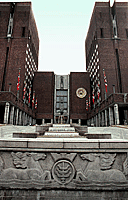 Clustered
around the head of the 68-mile-long Oslofjord, Oslo is probably the most
spacious city in the world. Its 175-square-mile metropolitan area
consists of over 75 percent forests and five percent water. Its fine
deep harbor, Pipervika, stretches into the heart of the city and from it
leave ferries to Denmark and Germany.
Clustered
around the head of the 68-mile-long Oslofjord, Oslo is probably the most
spacious city in the world. Its 175-square-mile metropolitan area
consists of over 75 percent forests and five percent water. Its fine
deep harbor, Pipervika, stretches into the heart of the city and from it
leave ferries to Denmark and Germany.




 In
the early Middle Ages, driven by famine at home and the promise of
wealth to be had in other lands, the Vikings set out from Scandinavia to
conquer parts of England, Ireland, France, Russia, and even Turkey.
Bolstered by their successes, the Vikings pushed westward, eventually
crossing the North Atlantic and founding settlements in Iceland,
Greenland, and Newfoundland in Canada.
In
the early Middle Ages, driven by famine at home and the promise of
wealth to be had in other lands, the Vikings set out from Scandinavia to
conquer parts of England, Ireland, France, Russia, and even Turkey.
Bolstered by their successes, the Vikings pushed westward, eventually
crossing the North Atlantic and founding settlements in Iceland,
Greenland, and Newfoundland in Canada.