Clustered
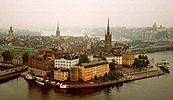
around the head of the 68-mile-long Oslofjord, Oslo is probably the most
spacious city in the world. Its 175-square-mile metropolitan area
consists of over 75 percent forests and five percent water. Its fine
deep harbor, Pipervika, stretches into the heart of the city and from it
leave ferries to Denmark and Germany.
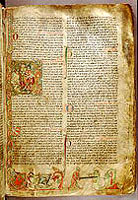
The sagas of the Icelanders give the impression that the earliest generations of Icelanders had a strong sense of nationality and felt distinct from the Norwegians, but it is necessary to
remember that these were written in a world two centuries removed from the Saga Age.
Yet there was recognition, even 200 years later, that Norway was the center and they themselves were the periphery; Norway, not Iceland, was the focus of attention. In the sagas and the histories, Iceland is outside while Norway is "home." The Icelanders "sail out" to Iceland but "sail home" to Norway.. In the sagas, there’s avid interest in how Norwegian royalty view the Icelanders. The kings and earls are always impressed by how splendidly handsome, intelligent, well-mannered, noble in behavior, and accomplished in sports the Icelanders are.
Continual emphasis is placed on the noble lineage of the Icelandic adventurers, many of whom are alleged to be descended from Norwegian kings. All of this should be taken with a grain of salt.
One peculiar way that the ancient Icelanders continued to see the world from a Norwegian perspective was their terminology for points of the compass. They persisted in calling "inland" northeast. This worked satisfactorily for Norway but was a fiction for most of Iceland. People from Ireland, Britain, and the islands of the North Atlantic are spoken of in the old literature as coming from "the west." Again, this made sense in Norway but not at all in Iceland.
Icelanders continue to remain closest in sentiment to Norway as the mother country and to Norwegians as a people more like them than any other. The feeling is perhaps akin to the feelings English Canadians have toward England.
Every year about 95 000 people die in
Sweden and, according to the law, everyone must be buried. There must be
room for everyone in the cemeteries, therefore the future needs of space
have to be predicted. Because of this funerals must be part of the
planning process.
In
the early Middle Ages, driven by famine at home and the promise of
wealth to be had in other lands, the Vikings set out from Scandinavia to
conquer parts of England, Ireland, France, Russia, and even Turkey.
Bolstered by their successes, the Vikings pushed westward, eventually
crossing the North Atlantic and founding settlements in Iceland,
Greenland, and Newfoundland in Canada. Read
moreGo to the Book Shop >














 Clustered
around the head of the 68-mile-long Oslofjord, Oslo is probably the most
spacious city in the world. Its 175-square-mile metropolitan area
consists of over 75 percent forests and five percent water. Its fine
deep harbor, Pipervika, stretches into the heart of the city and from it
leave ferries to Denmark and Germany.
Clustered
around the head of the 68-mile-long Oslofjord, Oslo is probably the most
spacious city in the world. Its 175-square-mile metropolitan area
consists of over 75 percent forests and five percent water. Its fine
deep harbor, Pipervika, stretches into the heart of the city and from it
leave ferries to Denmark and Germany.

 The sagas of the Icelanders give the impression that the earliest generations of Icelanders had a strong sense of nationality and felt distinct from the Norwegians, but it is necessary to
remember that these were written in a world two centuries removed from the Saga Age.
The sagas of the Icelanders give the impression that the earliest generations of Icelanders had a strong sense of nationality and felt distinct from the Norwegians, but it is necessary to
remember that these were written in a world two centuries removed from the Saga Age.



 In
the early Middle Ages, driven by famine at home and the promise of
wealth to be had in other lands, the Vikings set out from Scandinavia to
conquer parts of England, Ireland, France, Russia, and even Turkey.
Bolstered by their successes, the Vikings pushed westward, eventually
crossing the North Atlantic and founding settlements in Iceland,
Greenland, and Newfoundland in Canada.
In
the early Middle Ages, driven by famine at home and the promise of
wealth to be had in other lands, the Vikings set out from Scandinavia to
conquer parts of England, Ireland, France, Russia, and even Turkey.
Bolstered by their successes, the Vikings pushed westward, eventually
crossing the North Atlantic and founding settlements in Iceland,
Greenland, and Newfoundland in Canada.