Clustered
around the head of the 68-mile-long Oslofjord, Oslo is probably the most
spacious city in the world. Its 175-square-mile metropolitan area
consists of over 75 percent forests and five percent water. Its fine
deep harbor, Pipervika, stretches into the heart of the city and from it
leave ferries to Denmark and Germany.
Whatever the season
or cause for celebration, Skal! is the toast.
Foreigners are always immensely amused by
Norwegian drinking laws. There’s a certain humor in laws that permit
people to buy a whole crate of beer at the local store, but not one
bottle on its own. Or when a local inhabitant is refused a drink on the
terrace of the local hotel, while his good friend from the neighboring
town can order as much as he likes. This is the tail-end of a tradition
of fighting the evils of alcoholism that Asbjorn Kloster, a pioneer in
prohibition, inaugurated a century ago. A campaign that meets with
little enthusiasm today.
Norwegians have extraordinarily long and strong
traditions in drinking and drunkenness. The Norwegian hero of Viking
times, Olav Tryggvason, got people drunk so he could set fire to their
houses if they refused to become Christians.
"They longed for the intoxicating drink as
a bear longs for honey," runs another description of the Vikings,
who would travel great distances in foreign parts in order to get wine
while on their plundering trips to the Mediterranean. "Rich
merchants live well and drink fairly heavily, "wrote
Jacques de la
Tocnaye, a French traveler. Europeans must have learned the art of
distilling liquor some time after the end of the Viking period, but
Archhishop Olav Engelbrektsson first introduced alcohol distilling to
Norway in Trondheim in 1530. Once in the country, distilling apparatus
became as normal a part of household equipment as pots and pans.
It just had to go wrong for the drink-crazy
Norwegians. The battle against the Demon was launched in the middle of
the 16th century, when it became forbidden to serve spirits
(hard liquor) on Sundays and holidays–a law that stands to this day.
Despite all regulations, people went on making spirits, first from
grain, then from potatoes when they were introduced in the 18th century.
At about that time distilling became illegal, though the government
repealed the law in 1816. Once more consumption increased dramatically,
reaching 32 pints of spirits per citizen in 1833. It was this that led
to the temperance movement.
In 1848 a law on the manufacture and processing
of spirits put an end to home distilling. However, industrial distilling
was legal. In 1832, there were 10,000 registered distilleries in the
Norway, twenty years later there were only 40, thus halving the number
of establishments licensed for the sale and serving of spirits. By 1851
the consumption of spirits had fallen to 12 pints per person.
The Norwegian government enforced prohibition
from 1916 to 1927, and for a few years even fortified wine. Since 1922
the State has had a monopoly on the distribution and sale of wines and
spirits in the country, and since 1927 over the production of spirits as
well. Today, six distilleries sell spirits to the Wine Monopoly, about
two million litres a year. About 2,000 farmers send potatoes to be
distilled. The Wine Monopoly carries out production in Hamar Oslo,
Bergen and Trondheim, and sells it in 95 shops throughout the country.
In latter years there has been a relaxation in
alcohol legislation. It’s still not possible to buy wine in the local
store, as in Denmark and most other European countries. But in 1955 only
half the population of Norway could buy beer in their own parish. Now
97.3 per cent of the population can not only purchase wine, but about 50
per cent live in one that has a Wine Monopoly outlet.
Every year about 95 000 people die in
Sweden and, according to the law, everyone must be buried. There must be
room for everyone in the cemeteries, therefore the future needs of space
have to be predicted. Because of this funerals must be part of the
planning process.
In
the early Middle Ages, driven by famine at home and the promise of
wealth to be had in other lands, the Vikings set out from Scandinavia to
conquer parts of England, Ireland, France, Russia, and even Turkey.
Bolstered by their successes, the Vikings pushed westward, eventually
crossing the North Atlantic and founding settlements in Iceland,
Greenland, and Newfoundland in Canada. Read
moreGo to the Book Shop >














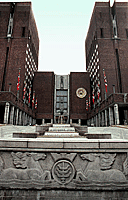 Clustered
around the head of the 68-mile-long Oslofjord, Oslo is probably the most
spacious city in the world. Its 175-square-mile metropolitan area
consists of over 75 percent forests and five percent water. Its fine
deep harbor, Pipervika, stretches into the heart of the city and from it
leave ferries to Denmark and Germany.
Clustered
around the head of the 68-mile-long Oslofjord, Oslo is probably the most
spacious city in the world. Its 175-square-mile metropolitan area
consists of over 75 percent forests and five percent water. Its fine
deep harbor, Pipervika, stretches into the heart of the city and from it
leave ferries to Denmark and Germany.

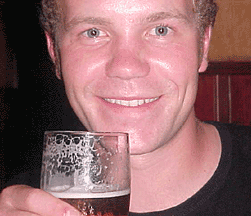 Whatever the season
or cause for celebration, Skal! is the toast.
Whatever the season
or cause for celebration, Skal! is the toast.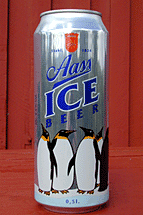 It just had to go wrong for the drink-crazy
Norwegians. The battle against the Demon was launched in the middle of
the 16th century, when it became forbidden to serve spirits
(hard liquor) on Sundays and holidays–a law that stands to this day.
Despite all regulations, people went on making spirits, first from
grain, then from potatoes when they were introduced in the 18th century.
At about that time distilling became illegal, though the government
repealed the law in 1816. Once more consumption increased dramatically,
reaching 32 pints of spirits per citizen in 1833. It was this that led
to the temperance movement.
It just had to go wrong for the drink-crazy
Norwegians. The battle against the Demon was launched in the middle of
the 16th century, when it became forbidden to serve spirits
(hard liquor) on Sundays and holidays–a law that stands to this day.
Despite all regulations, people went on making spirits, first from
grain, then from potatoes when they were introduced in the 18th century.
At about that time distilling became illegal, though the government
repealed the law in 1816. Once more consumption increased dramatically,
reaching 32 pints of spirits per citizen in 1833. It was this that led
to the temperance movement.

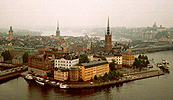

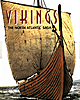 In
the early Middle Ages, driven by famine at home and the promise of
wealth to be had in other lands, the Vikings set out from Scandinavia to
conquer parts of England, Ireland, France, Russia, and even Turkey.
Bolstered by their successes, the Vikings pushed westward, eventually
crossing the North Atlantic and founding settlements in Iceland,
Greenland, and Newfoundland in Canada.
In
the early Middle Ages, driven by famine at home and the promise of
wealth to be had in other lands, the Vikings set out from Scandinavia to
conquer parts of England, Ireland, France, Russia, and even Turkey.
Bolstered by their successes, the Vikings pushed westward, eventually
crossing the North Atlantic and founding settlements in Iceland,
Greenland, and Newfoundland in Canada.