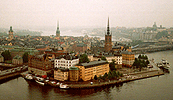
Clustered
around the head of the 68-mile-long Oslofjord, Oslo is probably the most
spacious city in the world. Its 175-square-mile metropolitan area
consists of over 75 percent forests and five percent water. Its fine
deep harbor, Pipervika, stretches into the heart of the city and from it
leave ferries to Denmark and Germany.
Scandinavia's
Greatest
Archaeological Treasure by Bob
Brooke
Covered
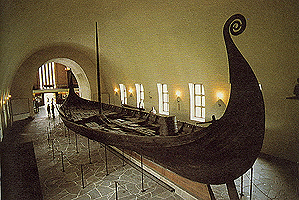
for a millennium by a ton of stone and turf, the Oseberg ship is one of
Scandinavia's greatest archaeological treasures. The ship, excavated at
the Oseberg farm near Oslo, Norway, in 1904, had been a royal burial
place. The items found found within it have made it a valuable source of
information about the arts, crafts and culture of the early Viking Age.
Historians
believe the Oseberg ship may have been the tomb of Queen Asa, who Gudrod
the Magnificent, a Norwegian ruler, had abducted and forced to marry
him. According to legend, she hated Gudrod and had him murdered as he
lay in a drunken stupor. She assumed his throne until her death in about
850, when her subjects placed her body in a ship brought ashore from
Oslo fjord.
The
Oseberg ship was clearly the burial place of an important personage.
Archaeologists found two female skeletons, one of them possibly a maid
servant who had been sacrificed as part of the funeral ritual. Personal
possessions–beds, looms, and kitchen utensils–which might comfort or
serve a queen in the afterlife, surrounded the remains. Should her ghost
wish to travel, the burial ship had sailing gear, including a mast and a
full set of 30 oars, as well as four sleighs and an ornately decorated
cart.
Decorations
on the wooden cart found in the ship suggest that the vehicle, some five
meters long, belonged to a wealthy or royal Viking rather than a humble
farmer. Carvings on the front depict a man fighting with snakes,
possibly a scene from the life of Gunnar, a hero of Norse mythology.
Fully
restored, the Oseberg burial ship stands in the Viking Ship Museum in
Oslo, Norway. Made of oak planking held together with iron rivets, the
ship is 21.5 meters long, with an elaborately covered prow and a stern
soaring 5 meters above the deck.
Every year about 95 000 people die in
Sweden and, according to the law, everyone must be buried. There must be
room for everyone in the cemeteries, therefore the future needs of space
have to be predicted. Because of this funerals must be part of the
planning process.
In
the early Middle Ages, driven by famine at home and the promise of
wealth to be had in other lands, the Vikings set out from Scandinavia to
conquer parts of England, Ireland, France, Russia, and even Turkey.
Bolstered by their successes, the Vikings pushed westward, eventually
crossing the North Atlantic and founding settlements in Iceland,
Greenland, and Newfoundland in Canada. Read
moreGo to the Book Shop >














 Clustered
around the head of the 68-mile-long Oslofjord, Oslo is probably the most
spacious city in the world. Its 175-square-mile metropolitan area
consists of over 75 percent forests and five percent water. Its fine
deep harbor, Pipervika, stretches into the heart of the city and from it
leave ferries to Denmark and Germany.
Clustered
around the head of the 68-mile-long Oslofjord, Oslo is probably the most
spacious city in the world. Its 175-square-mile metropolitan area
consists of over 75 percent forests and five percent water. Its fine
deep harbor, Pipervika, stretches into the heart of the city and from it
leave ferries to Denmark and Germany.




 In
the early Middle Ages, driven by famine at home and the promise of
wealth to be had in other lands, the Vikings set out from Scandinavia to
conquer parts of England, Ireland, France, Russia, and even Turkey.
Bolstered by their successes, the Vikings pushed westward, eventually
crossing the North Atlantic and founding settlements in Iceland,
Greenland, and Newfoundland in Canada.
In
the early Middle Ages, driven by famine at home and the promise of
wealth to be had in other lands, the Vikings set out from Scandinavia to
conquer parts of England, Ireland, France, Russia, and even Turkey.
Bolstered by their successes, the Vikings pushed westward, eventually
crossing the North Atlantic and founding settlements in Iceland,
Greenland, and Newfoundland in Canada.