Clustered
around the head of the 68-mile-long Oslofjord, Oslo is probably the most
spacious city in the world. Its 175-square-mile metropolitan area
consists of over 75 percent forests and five percent water. Its fine
deep harbor, Pipervika, stretches into the heart of the city and from it
leave ferries to Denmark and Germany.
Sweden
is one of Scandinavia’s most affluent countries. There are plenty of
smart properties, large cars, big and numerous motor cruisers, the
proliferation of sleek trailers, big–sometimes huge–and well-stocked
supermarkets, and in the considerable automation of many of its
services.
Sweden's vital statistics alone are enough to
fire the imagination of enthusiasts of wide open spaces. About 1,000
miles long by 240 miles wide, with 4,000 miles of coastline, 150,000
islands and 96,000 lakes, Sweden has a population of about 8 million.
The impact of its landscapes falls somewhere between the hugeness of
Finland's horizons and the ruggedness of Norway's heights, yet it has
more streamlined and sophisticated amenities than either of its
neighbors.
The country’s fluctuating fortunes have left
their stamp on the countryside which vies with Denmark especially in the
number of churches, castles and manor houses that punctuate the fertile
southern farmlands. These southlands are in great contrast to the fells
and forests, wild river valleys and immense lakescapes elsewhere. Like
their neighbors, the Swedes escape into the countryside at every
opportunity, and they’re well equipped to make the most of it,
whatever their taste in outdoor activities. Hotel voucher schemes,
well-equipped self-catering accommodation, excellent campsites and
transport bargains simplify holiday life at all budget levels.
Perhaps due to a sense of loss felt in the
shift away from the simple priorities and culture bred by the
wilderness, there’s now a considerable movement to reaffirm traditions
and to encourage or revive ancient crafts. Thus, folk culture is still
strong in many regions and enterprises devoted to hemslojd or
cottage industry proliferate' and range from regional organizations
dedicated to maintaining high standards and researching forgotten skills
to small workshops in the countryside, often set up by fugitives from
city life.
Every year about 95 000 people die in
Sweden and, according to the law, everyone must be buried. There must be
room for everyone in the cemeteries, therefore the future needs of space
have to be predicted. Because of this funerals must be part of the
planning process.
In
the early Middle Ages, driven by famine at home and the promise of
wealth to be had in other lands, the Vikings set out from Scandinavia to
conquer parts of England, Ireland, France, Russia, and even Turkey.
Bolstered by their successes, the Vikings pushed westward, eventually
crossing the North Atlantic and founding settlements in Iceland,
Greenland, and Newfoundland in Canada. Read
moreGo to the Book Shop >














 Clustered
around the head of the 68-mile-long Oslofjord, Oslo is probably the most
spacious city in the world. Its 175-square-mile metropolitan area
consists of over 75 percent forests and five percent water. Its fine
deep harbor, Pipervika, stretches into the heart of the city and from it
leave ferries to Denmark and Germany.
Clustered
around the head of the 68-mile-long Oslofjord, Oslo is probably the most
spacious city in the world. Its 175-square-mile metropolitan area
consists of over 75 percent forests and five percent water. Its fine
deep harbor, Pipervika, stretches into the heart of the city and from it
leave ferries to Denmark and Germany.

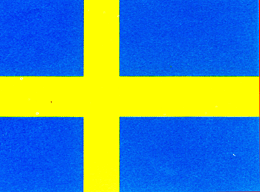 Sweden
is one of Scandinavia’s most affluent countries. There are plenty of
smart properties, large cars, big and numerous motor cruisers, the
proliferation of sleek trailers, big–sometimes huge–and well-stocked
supermarkets, and in the considerable automation of many of its
services.
Sweden
is one of Scandinavia’s most affluent countries. There are plenty of
smart properties, large cars, big and numerous motor cruisers, the
proliferation of sleek trailers, big–sometimes huge–and well-stocked
supermarkets, and in the considerable automation of many of its
services.

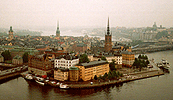

 In
the early Middle Ages, driven by famine at home and the promise of
wealth to be had in other lands, the Vikings set out from Scandinavia to
conquer parts of England, Ireland, France, Russia, and even Turkey.
Bolstered by their successes, the Vikings pushed westward, eventually
crossing the North Atlantic and founding settlements in Iceland,
Greenland, and Newfoundland in Canada.
In
the early Middle Ages, driven by famine at home and the promise of
wealth to be had in other lands, the Vikings set out from Scandinavia to
conquer parts of England, Ireland, France, Russia, and even Turkey.
Bolstered by their successes, the Vikings pushed westward, eventually
crossing the North Atlantic and founding settlements in Iceland,
Greenland, and Newfoundland in Canada.