The
Ombudsman Fights for
the Rights of Individuals
by Bob Brooke
  The
office of ombudsman is a Scandinavian institution that has received much
attention in recent years. New Zealand and Canada and several states in
the U.S. and some of the new countries of Africa have adopted the idea,
and the name at least has been applied to officials in business concerns
and on college campuses. The
office of ombudsman is a Scandinavian institution that has received much
attention in recent years. New Zealand and Canada and several states in
the U.S. and some of the new countries of Africa have adopted the idea,
and the name at least has been applied to officials in business concerns
and on college campuses.
The concept of an
ombudsman originated in its present form with the Swedish constitution
of 1809, and it has been adopted and even extended in the other
Scandinavian countries such as Finland (1919), Denmark (1953), and
Norway (1962).
Bureaucracy sometimes
rides brutally over the rights of the individual, either because of
careless disregard, or because regulations cannot cover exceptional
cases, or for other reasons having to do with the fallibility of laws or
officials. Any society that seeks justice must provide channels for
appeal and correction of mistakes, but too often the procedures of
complaint go through the same governmental structure as the thing
objected to. Therefore, the Swedes provided for a judicial agent, the
Justitie Ombudsman (JO), acting under the authority of parliament to be
a watchdog over administrative officials and acts.
With the expansion of
bureaucracy the JO's task has grown in both complexity and importance.
Out of 1,000 plus complaints filed each year, from 75 to 90 percent are
rejected as petty or unjustified. But even in these cases the aggrieved
party has had the psychological satisfaction of a means of protest and
an explanation of why he or she was treated so. In scores of cases, Jos
have discovered errors or derelictions of duty. In these instances, the
JO ordinarily discusses the matter with the official concerned and tries
by persuasion to get the wrong righted. If necessary, the JO can take
the official to court, but this happens rarely because the prestige of a
JO’s position is usually sufficient to obtain compliance.
However, the JO doesn’t
have the power to change a law or a ruling. But, for example, if the JO
finds that a murder has been committed because the law didn’t permit
the police to detain an insane suspect, he or she can recommend a change
in the law–and he or she will be heard. A JO can also publicly
criticize a police chief who exceeds his authority by prohibiting an
unsavory town character from appearing on a public street-and get a
reversal of the ruling or castigate a priest for tearing down a poster
announcing a Salvation Army meeting, thus preventing a recurrence.
The JO is a person
respected in the community, with salary and position comparable to that
of a Supreme Court judge. He or she has the right to see all relevant
documents and access to whomever he wishes to consult. The press checks
with the JO each day, so the power of publicity is at the JO’s
disposal. The constitution of each country empowers the JO not only to
accept complaints from individuals but also to initiate proceedings
whenever he or she senses there may be injustice. Occasionally the JO
makes inspection trips, visiting courts, hospitals, schools, smelling
out little and big cases of wrongdoing, suggesting remedies.
The JO also makes an
annual report to Parliament but is never ordered by Parliament to
undertake a case or to desist from prosecution. Thus, the JO is a free
agent, appointed for a several-year period and frequently reappointed.
The JO has a deputy and a
staff of lawyers but still has difficulty handling the workload. The
office of JO gives people confidence that there’s someone concerned
not only with the welfare of society as a whole but with their own
rights as individuals.
< Back to Article Index |














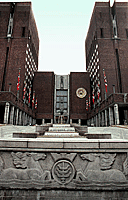 Clustered
around the head of the 68-mile-long Oslofjord, Oslo is probably the most
spacious city in the world. Its 175-square-mile metropolitan area
consists of over 75 percent forests and five percent water. Its fine
deep harbor, Pipervika, stretches into the heart of the city and from it
leave ferries to Denmark and Germany.
Clustered
around the head of the 68-mile-long Oslofjord, Oslo is probably the most
spacious city in the world. Its 175-square-mile metropolitan area
consists of over 75 percent forests and five percent water. Its fine
deep harbor, Pipervika, stretches into the heart of the city and from it
leave ferries to Denmark and Germany.




 In
the early Middle Ages, driven by famine at home and the promise of
wealth to be had in other lands, the Vikings set out from Scandinavia to
conquer parts of England, Ireland, France, Russia, and even Turkey.
Bolstered by their successes, the Vikings pushed westward, eventually
crossing the North Atlantic and founding settlements in Iceland,
Greenland, and Newfoundland in Canada.
In
the early Middle Ages, driven by famine at home and the promise of
wealth to be had in other lands, the Vikings set out from Scandinavia to
conquer parts of England, Ireland, France, Russia, and even Turkey.
Bolstered by their successes, the Vikings pushed westward, eventually
crossing the North Atlantic and founding settlements in Iceland,
Greenland, and Newfoundland in Canada.