Norden—The
North
by Bob Brooke
  It’s
"the rooftop of the world." Once the home of the Vikings,
it’s now a haven of peace. Once isolated off the routes of travel by
land and sea, it’s now on main air traffic routes. Once poor, it’s
now productive and prosperous. Barbarous late into European history,
it’s now an enlightened society. This is Scandinavia, Norden, the
North. It’s
"the rooftop of the world." Once the home of the Vikings,
it’s now a haven of peace. Once isolated off the routes of travel by
land and sea, it’s now on main air traffic routes. Once poor, it’s
now productive and prosperous. Barbarous late into European history,
it’s now an enlightened society. This is Scandinavia, Norden, the
North.
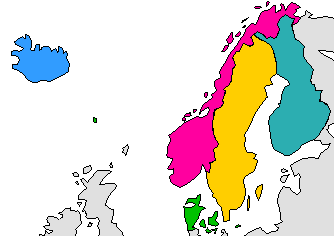
Scandinavia
includes Denmark, Norway, and Sweden, the eastern flank in Finland, the
western outposts in the Atlantic Ocean: the Faroes Iceland, and the
Danish colony of Greenland. The area reaches from the Russian border to
the shores of North America. It’s flanked on one side by polar seas,
and on the other by the Atlantic and the states of continental Europe.
It’s people have a common cultural tradition, have been in and out of
various political combinations with one another, and think of themselves
as a group. They have their differences–each of the five nations is an
entity–yet each is far more different from other nations outside the
group than it is from any of the brother nations within the group. Its
unity is based on geographical position and community of culture.
When
Scandinavia was on the frontier of civilization and conflict the people
could choose whether they wished to play the game of international war
and politics, or stand aloof. When they did choose to play they could
usually do so on other people's grounds. Swedes like to claim, for
instance, that their country has never been invaded, and even though the
claim is not literally accurate, it is almost so. Does this aloofness of
the past have significance in the mid-20th century? Is the idea of
the marginal position of northern Europe merely an illusion to which
wishful thinking clings? What are the geographical realities of today,
the pressures, the protective barriers which affect this section of the
earth?
The
countries of the North have been praised to the skies as lands of the
middle way and damned to the depths as selfish and blind in a confused
and embittered world. Neither view is correct.
To
understand these peoples one must assume certain fundamentals–common
sense, education, honesty, cooperativeness, hard work, a dash of good
luck, far-sighted planning, careful spending, a creative talent,
independent spirit, and democratic processes.
Progress
has been hampered sometimes by distance from supplies and markets,
sometimes by pride and stubbornness, sometimes by an overdose of the
independent spirit. Difficulties from plagues, wars, blockades
repeatedly have harassed the Scandinavians. But progress has been real
throughout the area. Perhaps the elements of that progress have meaning
for the rest of the world.
<
Back to Article
Index |














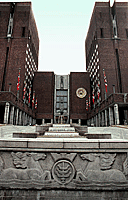 Clustered
around the head of the 68-mile-long Oslofjord, Oslo is probably the most
spacious city in the world. Its 175-square-mile metropolitan area
consists of over 75 percent forests and five percent water. Its fine
deep harbor, Pipervika, stretches into the heart of the city and from it
leave ferries to Denmark and Germany.
Clustered
around the head of the 68-mile-long Oslofjord, Oslo is probably the most
spacious city in the world. Its 175-square-mile metropolitan area
consists of over 75 percent forests and five percent water. Its fine
deep harbor, Pipervika, stretches into the heart of the city and from it
leave ferries to Denmark and Germany.



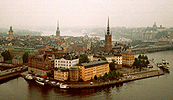

 In
the early Middle Ages, driven by famine at home and the promise of
wealth to be had in other lands, the Vikings set out from Scandinavia to
conquer parts of England, Ireland, France, Russia, and even Turkey.
Bolstered by their successes, the Vikings pushed westward, eventually
crossing the North Atlantic and founding settlements in Iceland,
Greenland, and Newfoundland in Canada.
In
the early Middle Ages, driven by famine at home and the promise of
wealth to be had in other lands, the Vikings set out from Scandinavia to
conquer parts of England, Ireland, France, Russia, and even Turkey.
Bolstered by their successes, the Vikings pushed westward, eventually
crossing the North Atlantic and founding settlements in Iceland,
Greenland, and Newfoundland in Canada.