Greenland—Western
Outpost of Scandinavia
by Bob
Brooke
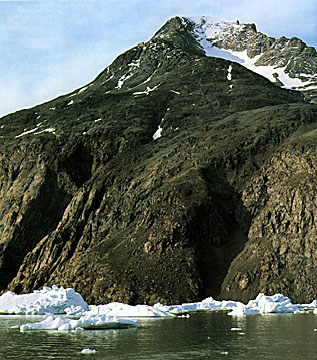 Greenland,
the world's largest island with an area of 840,000 square miles, is
larger than the combined area of Spain, France, Germany, and Italy. Greenland,
the world's largest island with an area of 840,000 square miles, is
larger than the combined area of Spain, France, Germany, and Italy.
From
Cape Farewell in the south to Cape Morris Jesup in the north is 1,650
miles, and the greatest width is 690 miles. From the northernmost point
it’s but 439 miles to the North Pole. Of its vast surface 86 percent
is covered by the inland ice cap, which reaches heights up to 10,000
feet. The ice averages about 5,000 feet thick. At the edges it’s
usually some 100 feet above sea level and throws off icebergs from its
glaciers directly into the sea or into the in-reaching bays and fjords
which indent the coast. Some of these more southerly glaciers move at
speeds of 65 to 125 feet per day.
Atop
the ice sheet the temperatures are always low, but in the coastal
regions there’s great variation. Within the month of February, the
town of Upernivik has had temperatures as high as 60 degrees Fahrenheit
and as low as -44 degrees. Precipitation varies from as little as six
inches per year at Danmarkshavn to as much as forty-six inches at
Ivigtut, and it’s almost all snow.
Current
life on the island has come from the West, both the sparse flora and the
animal life of land and sea–reindeer, fox, caribou, polar bear,
whales, seal, ptarmigan, even the native Greenlanders, whose Eskimo
ancestors came across from northern Canada.
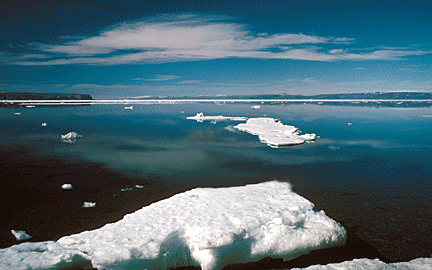 In two
areas an ice-free coastal strip is wide enough and conditions favorable
enough so that people can live in small settlements of people can exist.
In West Greenland, really the southern stretch of the west coast, the
ice retreats as much as 95 miles from the shore, and in some places
islands dot the coast. In East Greenland, about one-third of the total
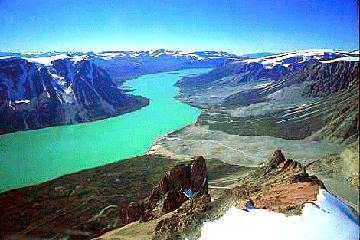
ice-free land, it’s 186 miles from sea to ice at Scoresby Sound. The
land is even more rugged here than in the west, with many peaks towering
over 6000 feet. In two
areas an ice-free coastal strip is wide enough and conditions favorable
enough so that people can live in small settlements of people can exist.
In West Greenland, really the southern stretch of the west coast, the
ice retreats as much as 95 miles from the shore, and in some places
islands dot the coast. In East Greenland, about one-third of the total
ice-free land, it’s 186 miles from sea to ice at Scoresby Sound. The
land is even more rugged here than in the west, with many peaks towering
over 6000 feet.
Along
these two coastal strips a population of some 48,000 scatters itself in
small communities–a few Eskimo, a few Danes, and a mixture of the two
called Greenlanders.
History
of Greenland
In 985 A.D., Eric the Red made his permanent settlements in the
southwest, first in the "Eastern Settlement," now the
Julianehaab District, and soon after in additional immigrants built up
the "Western Settlement," now the Godthaab District. Nearly
Icelanders and Norwegians may have lived in these two settlements around
the year 1000 A.D. It was Eric's son Leif who led the first expedition
to explore Vinland; and it was from these Greenland settlements that
successive attempts were made by others in the next few years to
colonize North America. But that was too far, demands for more land
weren’t pressing enough. The Vikings had reached their western limits.
The
Greenland colony seemed to prosper moderately until the 13th century.
But Greenland became increasingly dependent on Norway. In the mid-13th
century, it was forced to accept Norwegian overlordship, though the
people kept their local Althing. The Norwegians promised to send at
least one ship a year, but frequently the ship was lost.
 When
the Black Death scourged Norway in the mid-14th century, no ship went
out for several years. This became known as "the long
forgetfulness." An expedition to the Western Settlement in 1350
found only wild cattle and sheep, no human beings. When
the Black Death scourged Norway in the mid-14th century, no ship went
out for several years. This became known as "the long
forgetfulness." An expedition to the Western Settlement in 1350
found only wild cattle and sheep, no human beings.
At
last, in 1355, Norway sent Paul Knutson to try to check the decline of
Christianity, for King Magnus said, "We will not let it perish from
the earth." Unfortunately, Knutson didn’t find much, although the
Eastern Settlement still existed. Knutson evidently wrote no report on
his expedition, and mystery surrounds both of his exploits in North
America. Possibly Eskimos overcame the people, by this time few in
number and weakened by malnutrition. Or perhaps they migrated to the
North American mainland and were lost. Either way, the colony ceased to
exist.
Greenland’s
Rediscovery
Greenland's "rediscovery" dates from an expedition sent out by
Christian I of Denmark in 1472 or 1473, which was attacked by Eskimo in
East Greenland, near Angmagssalik. The king's purpose wanted to find a
northwest passage to China, which was also the primary aim of later
explorers such as Frobisher, Davis, and Baffin. Commercial interest grew
as English, Dutch, and Danes learned from the Basques the art of
harpooning whales.
<
Back to Article Index 1
2
next
page > |














 Clustered
around the head of the 68-mile-long Oslofjord, Oslo is probably the most
spacious city in the world. Its 175-square-mile metropolitan area
consists of over 75 percent forests and five percent water. Its fine
deep harbor, Pipervika, stretches into the heart of the city and from it
leave ferries to Denmark and Germany.
Clustered
around the head of the 68-mile-long Oslofjord, Oslo is probably the most
spacious city in the world. Its 175-square-mile metropolitan area
consists of over 75 percent forests and five percent water. Its fine
deep harbor, Pipervika, stretches into the heart of the city and from it
leave ferries to Denmark and Germany.




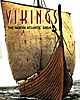 In
the early Middle Ages, driven by famine at home and the promise of
wealth to be had in other lands, the Vikings set out from Scandinavia to
conquer parts of England, Ireland, France, Russia, and even Turkey.
Bolstered by their successes, the Vikings pushed westward, eventually
crossing the North Atlantic and founding settlements in Iceland,
Greenland, and Newfoundland in Canada.
In
the early Middle Ages, driven by famine at home and the promise of
wealth to be had in other lands, the Vikings set out from Scandinavia to
conquer parts of England, Ireland, France, Russia, and even Turkey.
Bolstered by their successes, the Vikings pushed westward, eventually
crossing the North Atlantic and founding settlements in Iceland,
Greenland, and Newfoundland in Canada.