THE
BLISSFUL FINNISH SAUNA
by Bob Brooke
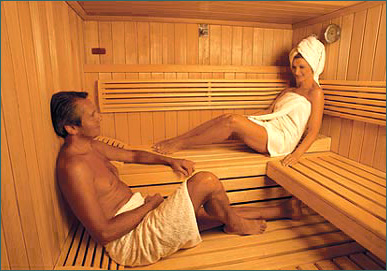
For the Finns the sauna
has always been important. In existence for at least a thousand years,
there are about 1.5 million saunas in Finland today, and considering the
Finland’s population is around five million, that’s a lot of
saunas.
Originally the sauna was
a place to bathe, but as it was the only available clean place with
abundant water, it has also been a place for giving birth and healing
the sick. ‘Sauna' is a Finnish-Sámi word. The heart of the sauna was
a pile of heated rocks around which bathers sat under a temporary cover,
just as Native Americans did in their sweat lodges. It’s possible
early man used sweat baths similar to saunas as long ago as 6,000 years,
during the Stone Age. However, the stoves in the dwellings at that time
were round, shallow fire pits, with two or three layers of smallish
stones at the bottom.
History
of the Sauna
It’s generally believed that the Finns built the first wooden saunas
in the 5th to 8th centuries. Originally single-room log buildings, they
were initially heated by fire and smoke. In those early days the
buildings served as both a dwelling and a sauna.
The basic principle of a
sauna is one of dry heat–that’s why the body can withstand
temperatures of 100̊C/212̊F and more. The heat comes from a
stove in a corner of the sauna, nowadays usually heated electrically,
but ideally by wood. Atop this is a pile of hot stones onto which the
person taking the sauna throws a small amount of water from time to
time, adding moisture to the air and giving the illusion of a sharp rise
in temperature.
After sweating it out,
the usual practice in a private sauna is to wash and shower or plunge
into sea or lake, then repeat the process as often as desired, usually
rounding off with quiet relaxation and a cold drink on the balcony
overlooking the water. During the winter, hardy Finns roll in the snow
or dip into a hole in the ice. Hotel or public saunas often impose a
time limit. Usually, there’s a place to relax and take refreshment
afterwards, an essential part of the process.. In the old days, farmers
usually built their sauna before the living quarters of their house.
They believed taking a sauna a cure for almost all imaginable ills.
Types
of Saunas
History has seen a variety of types of sauna in Finland. The nomad
people wandering around in what later became Finland already heated
holes in the ground and covered them with a tarp to have a warm place
for bathing. Later the sauna became a dedicated part of the house or
often a separate building slightly apart from the main habitat.
The smoke sauna is the
most traditional form of the sauna. It has a fireplace with no chimney;
the smoke exits through a small hole just below the roof. The sauna
builder piles stones, without using mortar, to create a fireplace, which
takes several hours to warm up. People used these fireplaces as late as
the 1920's. As inventors developed new types of stoves for sauna use,
the fireplaces began to disappear. Today, heaters have a metal casing
and a chimney, but still have stones to retain the heat. Saunas later
received running water, and new building materials transformed the sauna
into the kind of sauna known today.
Life
Rituals and the Sauna
In Finland the sauna has always been a sacred place for cleansing the
body, and above all the mind, during all the stages of human life from
birth to washing the dead. Without exception it was the women who
performed all the life-cycle rituals in the sauna. Generally, Finnish
women gave birth to their children in the sauna right up to the Second
World War. The sauna was a heatible, clean place, the most hygienic on a
farm. The tradition of up to a week-long confinement in the sauna,
followed by the newborn being ceremoniously carried into the house,
lived on until the early part of the 20th century.
In bygone days the sauna
was a sacred place to the Finns. Originally, farmers built their saunas
within the enclosure surrounding their farm buildings. A sauna’s
location by the lakeshore only goes back to the early 20th century
following the fashion of the gentry and upper-class who built villas for
recreation.
Heating
a Sauna
Then, people usually heated their saunas only once a week. Heating a
smoke sauna hot enough for several rounds of bathers took a whole day.
The task of picking out the right wood, laying the fire and stocking it
with wood went to a skilled fire tender, The key quality of a good fire
tender was to have an unhurried attitude in the process.
In many modern Finnish
houses the sauna is a main part of the bathroom. The heater is
electrical but other aspects of bathing in a sauna remain mainly
unchanged. The inner walls of a sauna are always made of wood–preferably
pine. Wood is the only natural material that doesn’t feel too hot to
the touch in high temperatures.
The feeling in a
wood-heated sauna is somewhat different from that of an electric sauna.
The wooden sauna has lately won new appreciation and the art of building
wood-heated saunas, even smoke saunas has been revived. A short swim in
a lake or cool Jacuzzi completes the perfect sauna experience.
Sauna
Behavior
A Finnish proverb says that people should behave in the sauna as they do
in church. Bathers are warned against shouting, cursing, telling tales,
bad-mouthing and breaking wind in the sauna. Parents teach their
children sauna manners though rules and warnings.
The widespread belief
that mixed bathing is customary in Finland is unfounded, and runs
counter to Finnish folk tradition. In a farming community, men and women
took turns to bathe, and the joint family sauna is a later phenomenon.
In the past, the farmer and his farmhands bathed first at the end of the
day's work in the fields and the farmer's wife and farm women second,
after they had milked the cows.
After taking a sauna
there’s no hurry to go anywhere. The feeling is blissful. The sauna
relaxes the body and soothes the mind. 'Re-created' best describes what
the refreshed mind feels after bathing in the dry heat.
< Back to Finland |














 Clustered
around the head of the 68-mile-long Oslofjord, Oslo is probably the most
spacious city in the world. Its 175-square-mile metropolitan area
consists of over 75 percent forests and five percent water. Its fine
deep harbor, Pipervika, stretches into the heart of the city and from it
leave ferries to Denmark and Germany.
Clustered
around the head of the 68-mile-long Oslofjord, Oslo is probably the most
spacious city in the world. Its 175-square-mile metropolitan area
consists of over 75 percent forests and five percent water. Its fine
deep harbor, Pipervika, stretches into the heart of the city and from it
leave ferries to Denmark and Germany.




 In
the early Middle Ages, driven by famine at home and the promise of
wealth to be had in other lands, the Vikings set out from Scandinavia to
conquer parts of England, Ireland, France, Russia, and even Turkey.
Bolstered by their successes, the Vikings pushed westward, eventually
crossing the North Atlantic and founding settlements in Iceland,
Greenland, and Newfoundland in Canada.
In
the early Middle Ages, driven by famine at home and the promise of
wealth to be had in other lands, the Vikings set out from Scandinavia to
conquer parts of England, Ireland, France, Russia, and even Turkey.
Bolstered by their successes, the Vikings pushed westward, eventually
crossing the North Atlantic and founding settlements in Iceland,
Greenland, and Newfoundland in Canada.