RECIPE
Cloudberry
Cream
 A
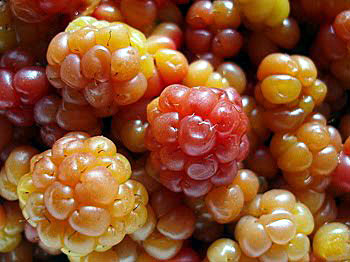
member of the rose family, cloudberry bushes produce delicious orange
berries that are smaller than blackberries and raspberries. Red before
ripening, the fruit turns soft and orange at maturity. Scandinavians
pick them from the end of July through the beginning of August. In a
good year, the Swedes, alone, buy and sell about a 1,000 tons of them.
Scandinavians call the abundant berries the "The Gold of the
Bogs," eat them fresh in season or make them into preserves. They
also use them to make liqueurs and as a filling in chocolate candies, as
well as making a tea that’s rich in vitamin C. For this reason, people
at cloudberries during the 18th and early 19th
centuries to combat gout and scurvy. A
member of the rose family, cloudberry bushes produce delicious orange
berries that are smaller than blackberries and raspberries. Red before
ripening, the fruit turns soft and orange at maturity. Scandinavians
pick them from the end of July through the beginning of August. In a
good year, the Swedes, alone, buy and sell about a 1,000 tons of them.
Scandinavians call the abundant berries the "The Gold of the
Bogs," eat them fresh in season or make them into preserves. They
also use them to make liqueurs and as a filling in chocolate candies, as
well as making a tea that’s rich in vitamin C. For this reason, people
at cloudberries during the 18th and early 19th
centuries to combat gout and scurvy.
A favorite dessert among Scandinavians is to
smother creamy vanilla ice cream with warm cloudberries. And Americans
love to spread cloudberry preserves on a fresh toasted bagel spread with soft cream
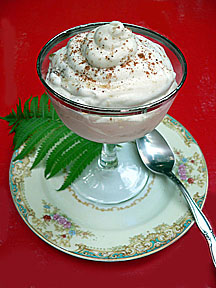
cheese. But for a real treat, try making some heavenly cloudberry cream.
Needed:
1 pint of whipping cream
1 small jar of cloudberry preserves or 3 tablespoons per serving
Whip the cream lightly, then carefully
fold in the preserves. For additional sweetness, add additional sugar.
Refrigerate for 30 minutes. Spoon into small bowls or stem glasses and
sprinkle lightly with nutmeg. Serve ice cold with a vanilla cookie if
desired.
 OR for a low-calorie alternative,
substitute OR for a low-calorie alternative,
substitute
1 container of fat-free non-dairy
cream topping for the whipping cream
If following the low-calorie
alternative, fold the preserves lightly into the fat-free topping. For
additional sweetness, add a small amount of artificial sweetener.
Refrigerate for 30 minutes. Spoon into small bowls or stem glasses and
sprinkle lightly with nutmeg. Serve ice cold with low-fat pretzel sticks
if desired.
Makes: 6 servings
Preparation time: 10 minutes
< Back to
A Taste of Scandinavia
Go to Danish Hash > |














 Clustered
around the head of the 68-mile-long Oslofjord, Oslo is probably the most
spacious city in the world. Its 175-square-mile metropolitan area
consists of over 75 percent forests and five percent water. Its fine
deep harbor, Pipervika, stretches into the heart of the city and from it
leave ferries to Denmark and Germany.
Clustered
around the head of the 68-mile-long Oslofjord, Oslo is probably the most
spacious city in the world. Its 175-square-mile metropolitan area
consists of over 75 percent forests and five percent water. Its fine
deep harbor, Pipervika, stretches into the heart of the city and from it
leave ferries to Denmark and Germany.




 In
the early Middle Ages, driven by famine at home and the promise of
wealth to be had in other lands, the Vikings set out from Scandinavia to
conquer parts of England, Ireland, France, Russia, and even Turkey.
Bolstered by their successes, the Vikings pushed westward, eventually
crossing the North Atlantic and founding settlements in Iceland,
Greenland, and Newfoundland in Canada.
In
the early Middle Ages, driven by famine at home and the promise of
wealth to be had in other lands, the Vikings set out from Scandinavia to
conquer parts of England, Ireland, France, Russia, and even Turkey.
Bolstered by their successes, the Vikings pushed westward, eventually
crossing the North Atlantic and founding settlements in Iceland,
Greenland, and Newfoundland in Canada.